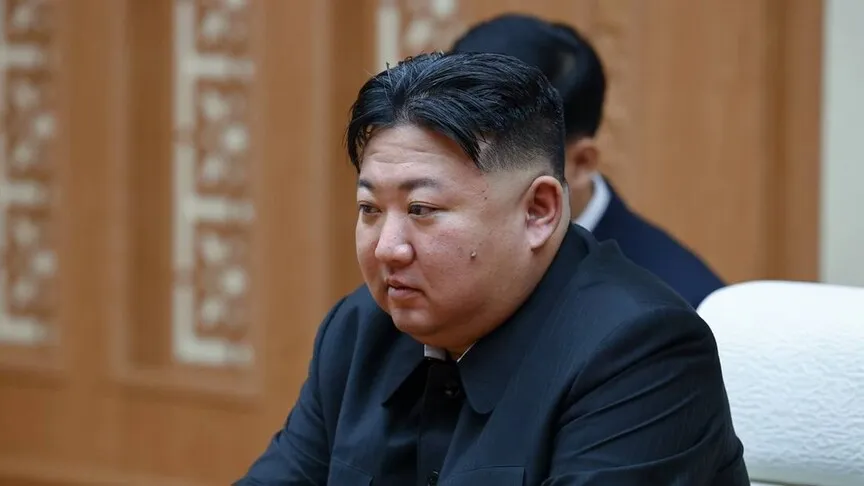
North Korea has asserted its readiness for both peace and war with the United States, contingent upon the U.S. recognizing its status as a nuclear-armed state. Kim Jong Un emphasized that there is no reason for conflict if Washington respects North Korea’s constitutional position, stating, “There is no reason why we cannot get on well with the U.S. if Washington respects the present position of our state specified in the constitution.” This declaration marks a significant moment in U.S.-North Korea relations, as the North’s nuclear status is now viewed as permanently fixed.
In a stark contrast, Kim Jong Un has dismissed any possibility of negotiations with South Korea, declaring that ties with the South are “completely eliminated.” This hardline stance underscores North Korea’s commitment to its nuclear weapons program and its intention to deter U.S. influence in the region.
Recent reports from the International Atomic Energy Agency indicate that North Korea’s 5-megawatt reactor at Yongbyon is likely still operational, further solidifying its nuclear capabilities. North Korea is also planning to deploy more advanced intercontinental ballistic missiles (ICBMs) and enhance its satellite launch capabilities, signaling an escalation in its military ambitions.
In the backdrop of these developments, speculation is growing regarding Kim Jong Un’s daughter, Kim Ju Ae, who is being considered a potential successor. At approximately 13 or 14 years old, she is the only publicly known child of Kim Jong Un and has appeared alongside him in public for over 600 days during a three-year period. This visibility has led analysts to suggest that the regime may be preparing for a fourth-generation leadership transition.
However, the political landscape in North Korea complicates succession planning. As a one-person rule country, the Kim family’s lineage is viewed as the sole legitimate source of leadership, making the transition of power particularly sensitive. Chan-il Ahn, a North Korean defector, noted that Kim Ju Ae’s public appearances are indicative of a shift toward this potential succession, while Park Won-gon highlighted that her gender poses challenges in a male-centered society.
Details remain unconfirmed regarding Kim Ju Ae’s exact age, as she may also be referred to as Ju-hae. Additionally, uncertainties persist about how the patriarchal norms of North Korea will influence her possible leadership role. As the Kim family has ruled North Korea since its founding in 1948, the implications of these developments are profound for the future of the regime and its relationship with the international community.